


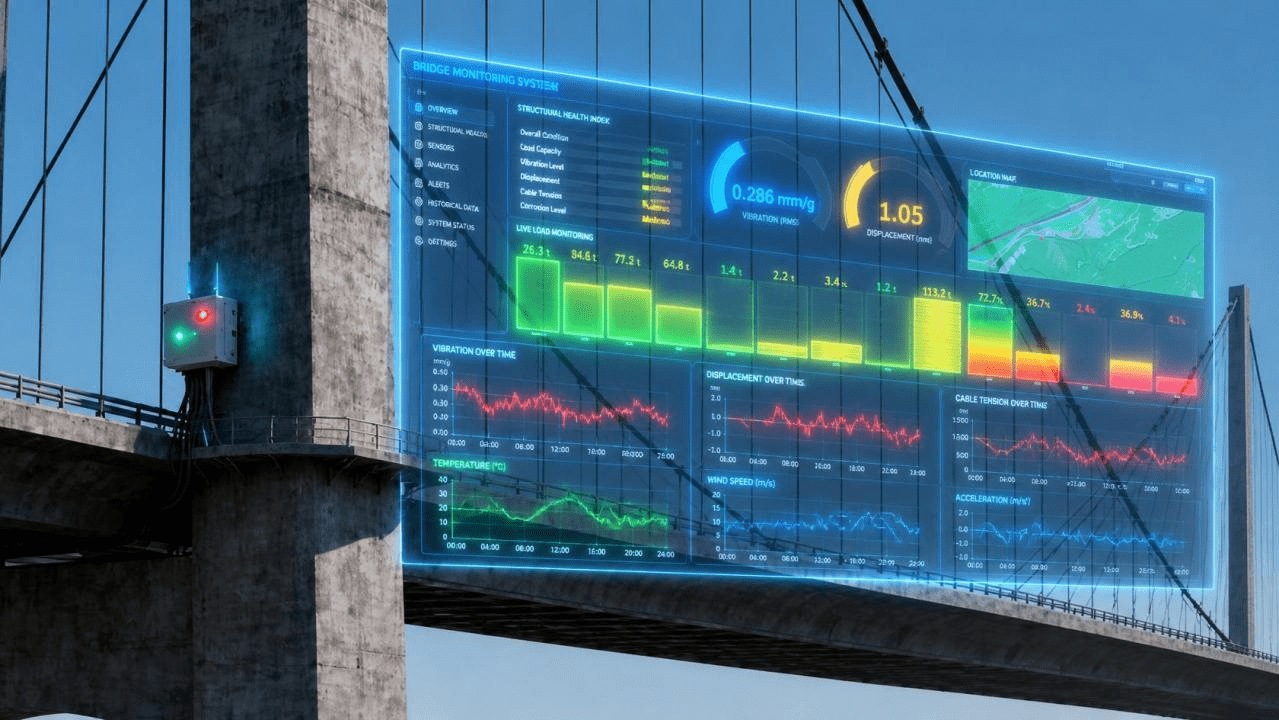
Infrastructure management is changing — and Italian regulations are making that shift increasingly clear.
With the 2026 update of the Operational Instructions for the Application of the Guidelines for Risk Classification, Safety Assessment and Monitoring of Existing Bridges, approved by the Italian Superior Council of Public Works following a proposal from ANSFISA, continuous structural monitoring officially becomes a central component of infrastructure safety management.
This marks an important step toward a paradigm shift already underway across the infrastructure sector: moving from reactive maintenance to predictive infrastructure management.
From Periodic Inspections to Continuous Understanding
For decades, bridge and viaduct safety relied mainly on:
- visual inspections;
- periodic assessments;
- localized testing;
- interventions performed only after deterioration became visible.
Today, however, aging infrastructure networks and increasing operational complexity require a different approach.
The updated regulations explicitly recognize the importance of:
- continuous monitoring;
- advanced sensing technologies;
- predictive models;
- data-driven assessments;
- digital decision-support systems.
In other words, infrastructure can no longer be evaluated through isolated inspections alone. It must be continuously understood over time.
What Changes With the 2026 Regulatory Update
The update to Operational Instruction 6.1.5.3.2 introduces an important development for infrastructure operators.
If planned rehabilitation or maintenance interventions are not completed within five years after the first transitability assessment, operators may still evaluate whether the bridge can remain in service under specific conditions.
Among these conditions, the regulation explicitly includes:
- implementation of structural monitoring systems;
- upgrading existing monitoring systems;
- definition of alert thresholds;
- continuous analysis of structural degradation;
- periodic safety reassessments.
Monitoring is therefore no longer treated as a secondary technical support activity, but as a strategic operational tool for infrastructure risk management.

The Strategic Role of Continuous Structural Monitoring
The updated regulation highlights a key principle: the possibility of keeping infrastructure safely operational increasingly depends on the ability to demonstrate its actual behavior through objective data.
This means that technologies such as:
- Structural Health Monitoring (SHM);
- Digital Twins;
- predictive analytics;
- IoT sensing systems;
- structural simulation;
are becoming essential tools to:
- support infrastructure operators;
- improve safety;
- optimize maintenance planning;
- reduce invasive interventions;
- enhance understanding of real structural conditions.
Continuous monitoring enables operators to:
- detect anomalies at an early stage;
- distinguish reversible effects from actual critical issues;
- track degradation evolution over time;
- dynamically update safety assessments.
A Paradigm Shift Already Underway
This regulatory update also represents an official acknowledgment of a technological transformation already happening across the infrastructure sector.
In recent years, advanced digital technologies have made it possible to:
- collect real-time data;
- integrate monitoring with numerical modeling;
- create infrastructure Digital Twins;
- automate parts of engineering analysis workflows.
In this context, monitoring evolves from passive observation into a cognitive system capable of actively supporting operational decisions.
Toward Smarter and More Resilient Infrastructure
For highway operators, public agencies, and infrastructure managers, the message is clear: the future of infrastructure safety will increasingly depend on the integration of data, simulation, and continuous monitoring.
The direction defined by the new regulations points toward infrastructure that is:
- more connected;
- more predictive;
- more digital;
- more resilient.
And within this transformation, technologies such as Digital Twins and Structural Health Monitoring are becoming key enablers of the next generation of infrastructure management.

