


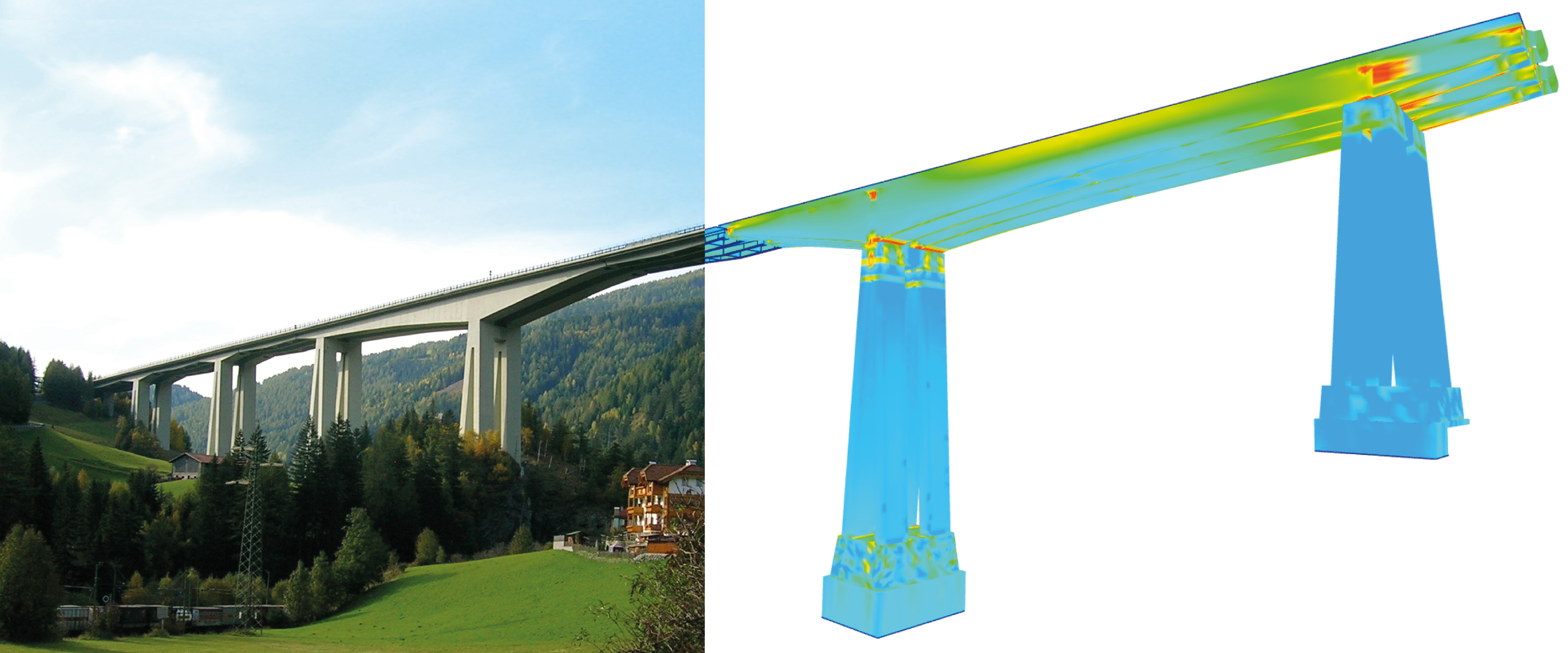

Six engineering challenges behind Twin Builder and the development of Digital Twins for Structural Health Monitoring.
Building a Digital Twin for Structural Health Monitoring (SHM) means much more than creating a digital or 3D representation of an infrastructure asset.
A true structural Digital Twin needs to connect FEM models, monitoring data, structural analysis, model calibration and artificial intelligence within a digital environment that can evolve together with the real structure. Making all these technologies work together is a significant engineering challenge.
It becomes even more complex when the objective is to transform them into a tool that structural engineers can use within their everyday workflows. This is one of the ideas behind Twin Builder, the new WeStatiX SHM module currently being developed by CAEmate.
Twin Builder is designed to enable engineering companies and structural professionals to build and configure their own Digital Twins, starting from the FEM models, monitoring systems and engineering knowledge they already have.
But how do you turn such a complex process into an accessible engineering workflow? Here are six of the main engineering challenges we are addressing while developing Twin Builder.
Six engineering challenges behind Twin Builder and the development of Digital Twins for Structural Health Monitoring
Building a Digital Twin for Structural Health Monitoring (SHM) means much more than creating a digital or 3D representation of an infrastructure asset.
A true structural Digital Twin needs to connect FEM models, monitoring data, structural analysis, model calibration and artificial intelligence within a digital environment that can evolve together with the real structure. Making all these technologies work together is a significant engineering challenge.
It becomes even more complex when the objective is to transform them into a tool that structural engineers can use within their everyday workflows. This is one of the ideas behind Twin Builder, the new WeStatiX SHM module currently being developed by CAEmate.
Twin Builder is designed to enable engineering companies and structural professionals to build and configure their own Digital Twins, starting from the FEM models, monitoring systems and engineering knowledge they already have.
But how do you turn such a complex process into an accessible engineering workflow? Here are six of the main engineering challenges we are addressing while developing Twin Builder.
FEM Model Interoperability: Making Structural Models Speak the Same Language
For many infrastructure projects, the starting point of a physics-based Digital Twin is an existing Finite Element Method (FEM) model.
Structural engineers already use sophisticated FEM software to represent bridges, dams and other infrastructure assets. But these models are created in different environments — such as SAP2000, MIDAS, SOFiSTiK and others — each with its own formats, modelling conventions and data structures.
A Digital Twin platform should not force engineers to rebuild those models from scratch.
One of the first challenges behind Twin Builder is therefore FEM model interoperability.
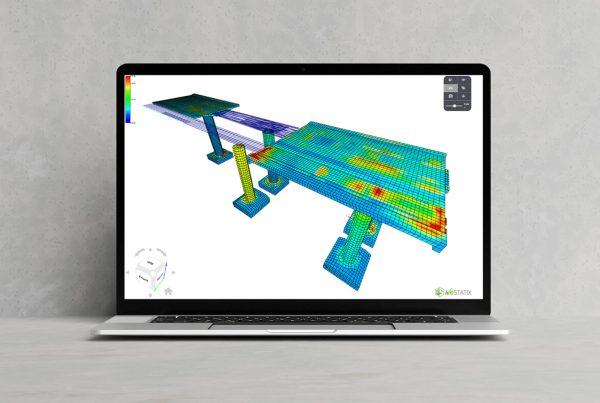
We are developing a Converter designed to interpret existing structural models and reconstruct them within the WeStatiX SHM environment while preserving the engineering information required for subsequent analyses: geometry, materials, mechanical properties, structural elements and boundary conditions.
The objective is to create a workflow in which existing engineering models become the foundation for building a Digital Twin.
Bring your FEM model. Build your Digital Twin.
Behind this apparently simple workflow lies one of the most complex aspects of making Digital Twin technology interoperable.
FEM Model Calibration: Connecting the Numerical Model with the Real Structure
A FEM model describes how a structure is expected to behave. A Digital Twin for Structural Health Monitoring needs to understand how that structure is actually behaving.
This distinction is fundamental.
Every numerical model contains assumptions regarding material properties, loads, constraints, boundary conditions and other structural parameters. The real asset, meanwhile, is continuously exposed to traffic, temperature variations, environmental conditions, ageing and changing operational conditions.
The challenge is therefore to connect simulated structural behaviour with measured structural behaviour.
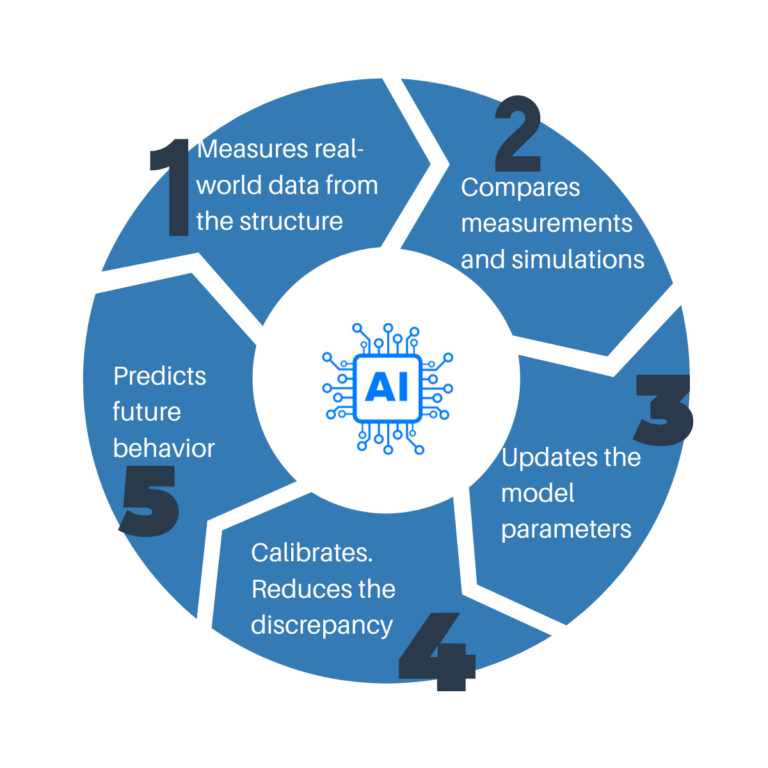
Twin Builder is being designed to integrate monitoring data with the numerical model so that measurements and simulations can be compared within the same environment.
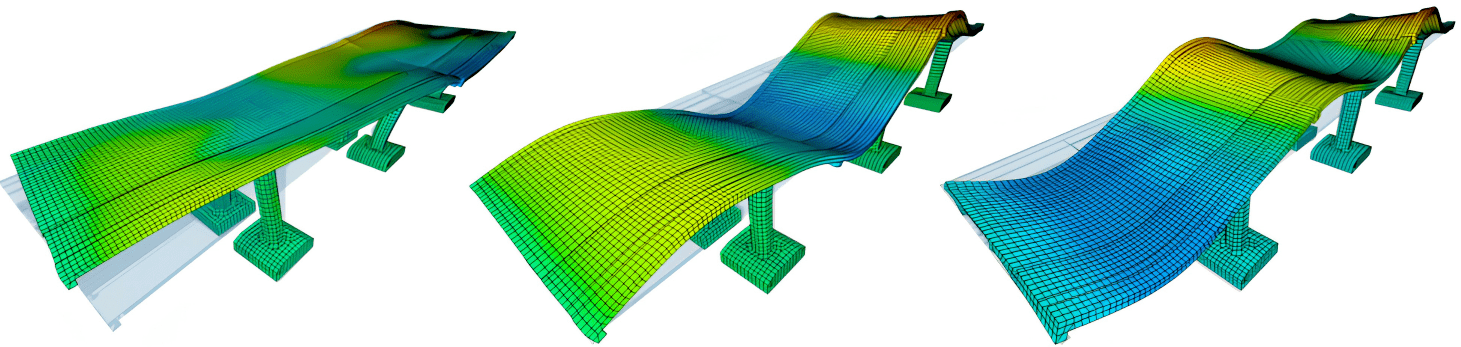
Techniques such as Operational Modal Analysis (OMA) can provide information about the actual dynamic properties of a structure, including natural frequencies, mode shapes and damping.
Monitoring data can then be used as an input for FEM model calibration, helping reduce discrepancies between numerical predictions and the behaviour measured on the real asset.
This creates a continuous connection between physical infrastructure and its numerical representation. The model is no longer static. It can evolve according to information coming from the real structure.
And that is a fundamental step in transforming a FEM model into a Digital Twin.
Physics-Based AI: Learning from Structural Scenarios That Have Never Happened
Artificial intelligence can identify patterns in large amounts of monitoring data. But infrastructure monitoring presents a particular problem: critical structural conditions are — fortunately — relatively rare.
A bridge may be monitored for years without experiencing significant damage. This raises an important question:
How can AI recognize abnormal structural behaviour if it has never seen it before?
One possible answer lies in combining artificial intelligence with physics-based structural simulation. Once a FEM model is available, engineers can simulate different structural conditions and scenarios by varying loads, material properties, environmental effects, boundary conditions or other relevant parameters.
These simulations can generate information about how the structure could behave under conditions that may not yet exist in its monitoring history. AI models can learn from this physics-based information and compare it with measurements coming from the real asset.
This creates an important connection between FEM simulation, structural monitoring and AI-based anomaly detection.
Instead of relying exclusively on historical monitoring data, the Digital Twin can use engineering physics to explore possible structural behaviours in advance.
Simulation becomes knowledge. Knowledge can support prediction.
Integrating FEM, Sensor Data, OMA and AI into One Digital Twin Workflow
A structural Digital Twin does not rely on a single technology.
Behind it lies an entire technological ecosystem:
FEM modelling, sensor data acquisition, data processing, Operational Modal Analysis, model calibration, structural simulation and artificial intelligence.
Each of these technologies is already complex on its own. Connecting them does not automatically create an effective Structural Health Monitoring platform.
One of the major challenges in developing Twin Builder is therefore turning these different technologies into one coherent engineering workflow.
This requires answering practical questions.
- What information does an engineer need at each stage?
- Which procedures can be automated?
- Which parameters require direct engineering control?
- How should monitoring data interact with the FEM model?
- And how can complex analyses be made understandable without oversimplifying their engineering meaning?
The objective is to create a workflow in which technologies that traditionally require different tools and specialized procedures can interact within the same environment.
The underlying technology can be complex. The engineering workflow should not have to be.
Making Digital Twin Technology Accessible Without Creating a Black Box
Simplifying complex engineering processes introduces another important challenge.
Building and maintaining a structural Digital Twin can require expertise in FEM modelling, Structural Health Monitoring, dynamic analysis, sensor data interpretation and model calibration.
Exposing every parameter and computational step would make the workflow difficult to manage. But hiding everything behind automation creates the opposite problem: the Digital Twin becomes a black box. For structural engineers, this is particularly problematic.
Understanding assumptions, parameters and model behaviour is essential for evaluating results and making informed decisions about infrastructure assets. Twin Builder is therefore being developed around a balance between automation and engineering control.
Guided workflows can simplify complex procedures and help users configure analyses correctly, while advanced settings can remain accessible when deeper control is required. The objective is not to hide engineering complexity.
It is to make engineering complexity manageable.
This distinction is essential if advanced Digital Twin technology is to become accessible to a broader range of engineering companies and infrastructure professionals.
Automating Structural Analysis Without Replacing Engineering Judgement
Perhaps the most important challenge behind Twin Builder is not purely technological.
Many decisions involved in creating a Digital Twin require engineering experience.
- How should an Operational Modal Analysis be configured?
- Which parameters should be included in FEM model calibration?
- How should environmental effects be separated from changes in structural behaviour?
- Which discrepancies between measurements and simulations are significant?
- And when the numerical model and monitoring data disagree, is the cause the structure, the model or the monitoring system?
These questions cannot simply be reduced to automated calculations. They require engineering judgement.
Through Twin Builder, we are working to translate part of the knowledge accumulated through research and real-world Structural Health Monitoring projects into guided and intelligent workflows.
Automation can manage repetitive calculations, process large amounts of monitoring data and support complex analyses.
But the final interpretation remains an engineering task. The goal is therefore not to replace structural engineers.
It is to provide them with better tools to understand structural behaviour, investigate anomalies and make informed decisions more efficiently.
Expertise remains human. The workflow becomes intelligent.
From FEM Models to Digital Twins for Structural Health Monitoring
These six challenges share a common objective.
Making advanced Digital Twin technology for infrastructure monitoring accessible to more engineers.
Today, creating a physics-based Digital Twin can require multiple software environments, specialized expertise and considerable effort to connect numerical models, sensor measurements and structural analysis procedures.
Twin Builder aims to reduce these barriers by bringing these elements into a more integrated workflow. The starting point can be an existing FEM model. Monitoring data connects that model with the real structure. Model calibration improves its ability to reproduce measured behaviour. Structural simulation allows engineers to investigate different scenarios.
Artificial intelligence helps identify patterns and anomalies within increasingly large amounts of data. Together, these technologies can transform a static numerical model into an evolving representation of the real infrastructure asset.
What Is Twin Builder?
Twin Builder is part of WeStatiX SHM, CAEmate’s platform for Structural Health Monitoring and Digital Twin applications.
It is being developed for engineering companies and structural professionals that want to create and manage Digital Twins using their own engineering models and monitoring data.
Rather than replacing the tools and expertise engineers already use, Twin Builder is designed to connect them within a unified workflow — from FEM model integration and sensor data management to model calibration, structural analysis and Digital Twin development.
The objective is to make advanced Structural Health Monitoring capabilities more accessible while maintaining the engineering transparency and control required for infrastructure applications.
For us, this is an important part of democratizing Structural Health Monitoring.
Not replacing engineers.
Not turning structural analysis into a black box.
But giving more engineering professionals access to advanced Digital Twin capabilities while preserving the scientific rigour, transparency and engineering judgement that infrastructure management demands.
Twin Builder. Build your Digital Twin.

